
Pune’s monsoon season brings welcome relief from the summer heat, but for machine shops and manufacturing units across the city’s industrial belts — Chakan, Bhosari, Hinjewadi, Pimpri, and Talegaon — it also brings a set of production headaches that quietly eat into tool life, part quality, and shop-floor efficiency. Rising humidity, fluctuating temperatures, and moisture-laden air don’t just make the commute harder; they change how metal behaves under the cutting edge.
Here’s a closer look at what monsoon does to machining operations in Pune, and why carbide cutting tools are one of the most effective ways to keep production steady through the wet months. This is where Sperocut comes in — our carbide cutting tools are engineered to hold their edge and accuracy through exactly these conditions, helping Pune manufacturers avoid the seasonal dip in tool life and part quality that monsoon typically brings.
Why Monsoon Is Tough on Machining Shops
1. Humidity Accelerates Corrosion
Pune’s monsoon humidity levels often stay elevated for weeks at a stretch. This moisture doesn’t just affect machine beds and fixtures — it settles on raw stock, cutting tools, and finished components. Ferrous materials left exposed even overnight can develop surface rust, which then has to be cut through during machining. This adds inconsistent load on the tool edge and can mar surface finish on precision parts.
2. Coolant Contamination and Dilution
Airborne moisture works its way into coolant sumps and tanks, diluting concentration levels and encouraging bacterial growth in water-soluble coolants. Weakened coolant reduces lubrication and heat dissipation at the cutting zone, which shows up as poor chip evacuation, built-up edge, and shortened tool life — problems that often get blamed on the tool when the coolant is the real culprit.
3. Thermal and Dimensional Instability
Sudden temperature swings between rain-cooled mornings and humid afternoons cause micro-expansion and contraction in both machines and workpieces. For shops holding tight tolerances — common in automotive and precision engineering components manufactured around Pune — this seasonal instability can push parts outside spec if machining parameters aren’t adjusted.
4. Moisture Absorption in Cast and Forged Stock
Castings and forgings stored in open or semi-covered yards can absorb ambient moisture, especially porous grades. Machining slightly damp stock leads to unpredictable chip formation, occasional steam-like flash at the cutting zone, and increased tool wear from inconsistent material hardness across a batch.
5. Electrical and Equipment Downtime
High humidity increases the risk of condensation inside control panels and electrical cabinets, leading to intermittent faults, sensor drift, or unplanned downtime — indirectly affecting machining consistency even before the cutting tool comes into play.
How Carbide Cutting Tools Help Offset These Challenges
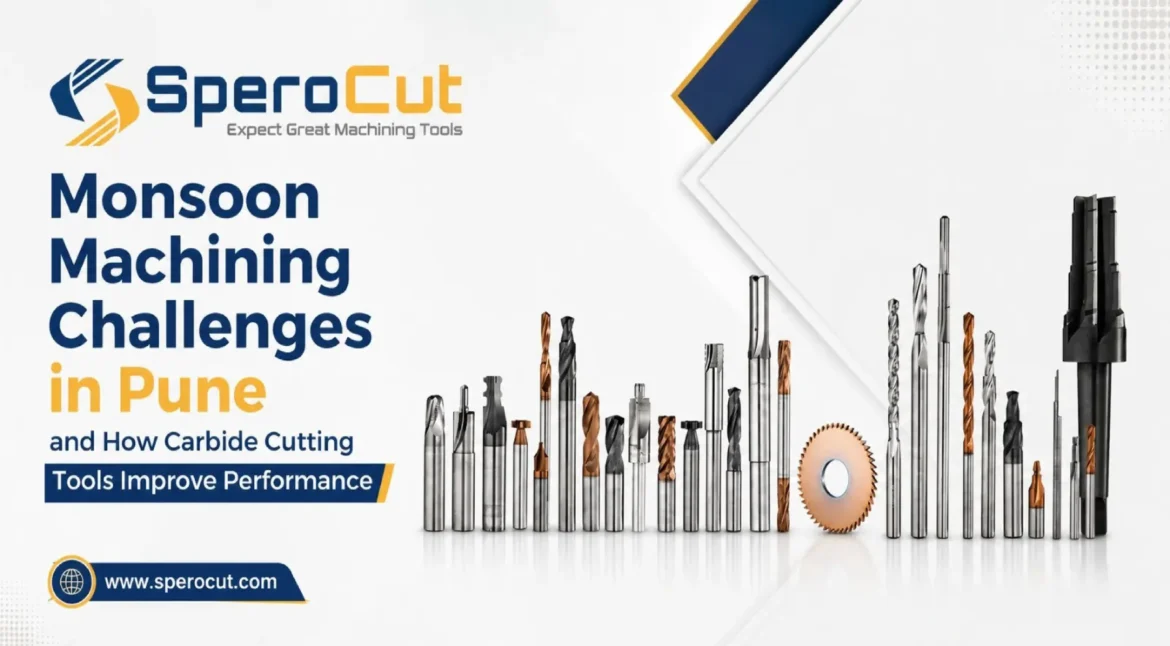
Carbide tooling — whether solid carbide or carbide-tipped/coated inserts — is built to handle exactly the kind of variable, high-stress conditions that monsoon machining creates.
Superior wear and corrosion resistance: Tungsten carbide, often combined with cobalt binders and coatings like TiAlN, TiN, or DLC, resists the surface degradation that comes from cutting through slightly rusted or moisture-affected stock. Coated carbide grades in particular add an extra layer of protection against oxidation and chemical attack from contaminated coolant.
High thermal stability: Carbide tools retain their hardness and cutting-edge geometry at temperatures far beyond what high-speed steel (HSS) tools can handle. This matters when ambient temperature swings and humidity-affected coolant performance make heat management less predictable — carbide simply has more margin before performance drops off.
Consistent dimensional accuracy: Because carbide holds its edge longer and resists deformation under heat and load, it helps maintain tighter, more repeatable tolerances even when workpiece material properties vary slightly due to moisture absorption — a real advantage for shops supplying automotive and precision components where Pune’s manufacturing base is strong.
Fewer tool changes, less downtime: Carbide’s wear resistance translates directly into longer tool life between changes. During monsoon, when other variables (coolant, humidity, material condition) are already less predictable, having one less variable to manage — tool wear — helps shops hold production schedules.
Better surface finish, less rework: A sharper, more stable cutting edge reduces the burnishing and tearing effects that come from cutting through inconsistent or slightly corroded stock, cutting down on secondary finishing and rework — both of which cost time and money when schedules are already tight.
Practical Tips for Pune Manufacturers This Monsoon
- Store raw stock and finished parts in dry, covered areas with dehumidification where possible.
- Check coolant concentration and condition more frequently than in dry months.
- Consider coated carbide inserts (TiAlN/DLC) for jobs involving stock that may have surface rust or moisture exposure.
- Apply rust-preventive coatings on machine beds, fixtures, and stored tooling during idle periods.
- Recalibrate machines periodically if working to tight tolerances, given seasonal thermal drift.
Choosing the Right Carbide Tooling Partner
Monsoon conditions expose the weak points in any machining process — and tooling is usually the first place shops feel the impact. Investing in the right grade of carbide tooling, matched to your material and application, is one of the most reliable ways to keep quality and output steady through Pune’s wettest months.
At Sperocut, we work with manufacturers across Pune’s industrial clusters to specify carbide cutting tools suited to their materials, tolerances, and seasonal operating conditions. If monsoon has been a recurring pain point in your shop, reach out — the right tooling choice can make more difference than most shops expect.